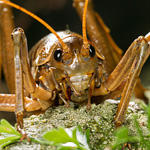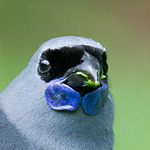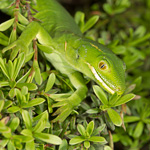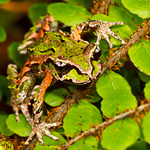
A close-up photo of a common skink. Taken with a Canon 1D Mark IV, EF100mm f/2.8 Macro USM, 1/160 s exposure at f11, ISO 1250, flash held off camera.
The Marlborough Region is rich with lizard species, and I managed to catch up with a couple of them this past spring while staying with friends on their high country station.
The common skink is a widespread species, found through much of New Zealand from about the middle of the North Island south, but the Marlborough mini gecko is endemic to the region.
The Marlborough mini is a small brown gecko, and like many of our native lizards it has not yet been formally described as a species. Many of our skinks and geckos are very similar in appearance, and the true diversity of our lizards is still being unravelled.
A Marlborough mini gecko crawling over moss and lichen covered rocks. Taken with a Canon 1D Mark IV, EF100mm f/2.8 Macro USM, 1/60 s at f9, ISO 1000, flash held off camera.
I was a little unprepared when I found these lizards (the joys of flying and luggage restrictions), and didn’t have with me some of the gear that I’d normally use in that situation. Still, I managed to improvise and make a few photos that I think were worthwhile.
A plumed whistling duck resting beside a small urban pond reflecting the fresh spring leaves of trees on the other side. Taken with a Canon 1D Mark IV, EF600mm f/4L IS USM + 1.4x TC, 1/500 s exposure at f10, ISO 400.
The latest additions to my website are a few images of plumed (grass) whistling ducks (Dendrocygna eytoni)—rare vagrants to New Zealand from Australia. Three of these stunning little ducks were discovered in a city park in Napier, and reported on BirdingNZ.net, and as soon as I could I was off to try to catch up with them. In Australia they feed on grasses and legumes near wetlands, and these birds in Napier seemed quite happy grazing the mown lawn of a urban park.
A tired little egret (Egretta garzetta) yawns while resting beside a small coastal wetland. Taken with a Canon 1D Mark IV, EF600mm f/4L IS USM, 1/250 s exposure at f9, ISO 200.
I have been a bit slow at uploading new photos recently. It’s that time of the year again when work, and life in general, seems to go into overdrive trying to get certain things done before the world grinds to a halt for a few weeks in late December. This is the worst time for nature photography, in my opinion. Beaches are crowded, many birds are looking scruffy in their old feathers, and the sun is too high for much of the day. Of course there are still loads of opportunities if one cares to look, but I hope to spend more time catching up on processing earlier photos. I have managed to add a couple of new shots of a reef heron shot on the Coromandel Peninsula, and a little egret that is a long time resident of a small coastal wetland in Hawke’s Bay. Little egrets are rare stragglers to New Zealand, and when they do turn up it is usually at a coastal wetland or estuary.
Wherever they like!
That might be on a the nearest vacant spot on the beach…
A New Zealand fur seal (Arctocephalus forsteri) sleeping on a kelp covered beach. Kaikoura, New Zealand. Taken with a Canon 1D Mark IV, EF70-200mm f/4L USM, 1/100 s exposure at f/9, ISO 640.
..or on the side of a road…
A New Zealand fur seal sleeping on the side of a road. It wasn’t injured, and it wasn’t at all fazed by passing traffic (even a beautifully painted scooter). Kaikoura, New Zealand. Taken with a Canon 1D Mark IV, EF70-200mm f/4L USM, 1/80 s exposure at f/7.1, ISO 400.
..or in a car park…
A flax plant makes a nice looking pillow for a New Zealand fur seal sleeping in a planted traffic island in a car park. Kaikoura, New Zealand. Taken with a Canon 1D Mark IV, EF70-200mm f/4L USM, 1/250 s exposure at f/7.1, ISO 640.
..or in the middle of a boardwalk built to help prevent people from disturbing sleeping seals…
Fur seals may spend several weeks at sea before coming ashore. People are warned to not disturbed them as they rest between foraging trips, and a boardwalk helps keep visitors separate from seals that may be sleeping under vegetation along this popular stretch of coast near Kaikoura. It seems though, that no one told the seals! Taken with a Canon 1D Mark IV, EF16-35mm f/2.8L II USM, 1/8 s exposure at f/6.3, ISO 250.
A handsome adult shore plover wading into a small rockpool. Taken with a Canon 1D Mark IV, EF600mm f/4L IS USM, 1/500 s exposure at f8, ISO 400.
Shore plovers (Thinornis novaeseelandiae) are amongst the most rare of shorebirds. They would once have been found around the coast of much of New Zealand, but they were decimated by the predatory mammals that arrived with humans, particularly cats and Norway rats, and pushed to the brink of extinction. They persisted only on a couple of small islands in the remote Chatham group, where their numbers dwindled to around 130 individuals. Recent conservation work has focussed on establishing new populations on other predator free islands. One of these is Mana Island, north west of Wellington, New Zealand’s capital. Since their release on Mana in 2007, shore plovers have regularly been seen along the adjacent mainland coast, usually in ones and twos, but in June 2011 a flock more than 30 were found on a little rocky beach at Plimmerton. Having more than 15% of the total word population of this endangered species on a highly accessible beach just a short drive north of the capital was a great opportunity for birders and bird photographers who visited from around the country, but risky for the endearing little plovers.
Being incredibly rare, and part of an intensively monitored population, virtually every one of the shore plovers at Plimmerton sported up to 5 leg bands, including some wonderfully vivid coloured bands. Great for ornithologists to identify individuals, but they don’t always look so good in photographs. I had to be a little creative. The photo here is one I was quite pleased with. It’s a beautiful adult, and you can’t see its bands. Of course, just being able to see these special birds was reward enough for the long drive, but a couple of good photos on top is even better!
You can see more shore plover photos in my web gallery.