Neil Fitzgerald Photography
Quick photo search

Posts tagged with 'macro'

New, bigger photos

Harvestman

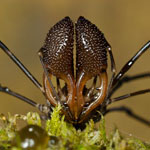
Recent uploads include some macro images of harvestmen, harmless spider-like creatures whose bodies are often bizarely proportioned. Also, new photos of albatrosses and other pelagic seabirds. But wait, there’s more! All these are now 44% bigger, at no extra cost! Screen sizes are bigger, and most people have faster internet connections than a few years ago, so I’ve started making new gallery photos larger, and as time allows I’ll reprocess some older ones.

Red percher dragonfly

I spent a few days in Northland last month photographing for a magazine article (more on that later). As is so often the norm for nature photographers, I was up before first light searching for an interesting subject, and hoping for nice light. It had been a wet start to autumn, so the ephemeral Lake Ohia was high, and after a cool clear night mist rose gently from the water surface. Careful planning and preparation had me comfortably in warm waders, so I was able to concentrate on photography.

Red percher

Red percher dragonfly (Diplacodes bipunctata) covered with drops of dew at sunrise. Taken with a Canon 1D Mark IV, EF180mm f/3.5L macro, 0.4 second exposure at f22, ISO 200.

As the world brightened, it became clear that the clouds were too few and in the wrong place for the stunning sunrise landscape I was hoping for, so I had to take a closer look at what I had to work with. I noticed spider webs and insects adorned with beads of dew hanging from sedges, torpid in the cool morning air. I worked to find a dragonfly that I could get a clear view of. I wanted to use the natural soft light of sunrise, so a tripod was mandatory to prevent camera shake at the required slow shutter speed. I had to carefully position the legs of the tripod, trying not to disturb the subject. With close-up photography, camera movements of just a few millimeters can completely change a composition, so this was a delicate process. My 180 mm macro lens gave me a little more working room compared to shorter macro lenses, and the narrower field of view allowed me to create a less cluttered background—both very useful in a fragile tangle of vegetation like this. As the first rays of sunlight lit the lake I worked quickly to make as many different images as possible—backlit, direct front lighting, even swapping the macro lens for a wide angle to include more of the surroundings. You can see some of them in my dragonfly album. The photo here is one of my favourites from that morning, although another was ultimately chosen for the magazine. I like this one for the warmth of the light and the clean background.

More North Cape green geckos

Green gecko

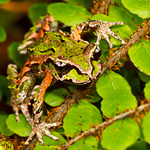
While in Northland last week to complete an assignment I found some North Cape green geckos, or yellow-lipped geckos as they are sometimes called (Naultinus sp. ‘North Cape green gecko’). Late last year I uploaded some photos of a single animal I found then, but I can’t get enough of these extremely photogenic little gems, so forgive me for adding some of these more recent discoveries as well. Seeing these beautiful little lizards in the wild is seldom easy, but is always a huge pleasure. As you can see from the photos in my web gallery, the patterns of golden flecks and stripes on these vivid green geckos varies from one individual to the next. One large female I photographed has a very thin line of yellow down each side, while a small juvenile found nearby (and here on the left), which may well be one of her offspring of the year, is much more boldly marked.

North Cape green (yellow-lipped) gecko

photo of a North Cape green/yellow-lipped gecko

On a recent trip to the Far North I found a North Cape green gecko, also known as yellow-lipped gecko. This species has yet to be described and the closest it has to an official name is the tag name Naultinus sp. ‘North Cape green gecko’.

Like our other green geckos, the North Cape green gecko is long lived, diurnal, gives birth to live young, and sadly is declining. The causes of decline are not completely known, and these lizards are so cryptic that monitoring their populations is difficult. However, at least some of the treats include habitat loss, predation by introduced mammalian predators, exotic wasps, and poaching for the illegal pet trade. Poaching disturbs me most, because it is purely about human greed and the people involved have no regard at all for the animals. All our native lizards are legally protected and must not be disturbed or harmed in any way.

North Cape green geckos are only found wild in scrub vegetation near the northern tip of North Island, in the Far North District of Northland. Although you might think their amazingly vivid shades of green would make them quite conspicuous, they can be very well camouflaged. North Cape green geckos are sexually dimorphic, which basically means males and females look different. Females have a pale green underside while males are pale blue (the individual I photographed on this occasion is a male). When either opens its mouth you can clearly see the yellow-orange lips and gums that separate it from similar species and give it one of its common names.

I have added photos of the North Cape green gecko to the lizards section of my gallery, including some stunning macro shots.

New butterfly images

copper butterfly photo

I have added a few new common copper and black mountain ringlet butterfly photos to the gallery. Check them out in the new images section. We don’t have a huge diversity of butterflies in New Zealand, but I recently photographed these locally common species in the South Island mountains. It was good to get back to a little macro photography.


home | gallery | profile | purchase | contact | links | articles | new
© Neil B. Fitzgerald 2006– All Rights Reserved