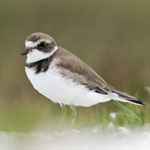
A handsome adult shore plover wading into a small rockpool. Taken with a Canon 1D Mark IV, EF600mm f/4L IS USM, 1/500 s exposure at f8, ISO 400.
Shore plovers (Thinornis novaeseelandiae) are amongst the most rare of shorebirds. They would once have been found around the coast of much of New Zealand, but they were decimated by the predatory mammals that arrived with humans, particularly cats and Norway rats, and pushed to the brink of extinction. They persisted only on a couple of small islands in the remote Chatham group, where their numbers dwindled to around 130 individuals. Recent conservation work has focussed on establishing new populations on other predator free islands. One of these is Mana Island, north west of Wellington, New Zealand’s capital. Since their release on Mana in 2007, shore plovers have regularly been seen along the adjacent mainland coast, usually in ones and twos, but in June 2011 a flock more than 30 were found on a little rocky beach at Plimmerton. Having more than 15% of the total word population of this endangered species on a highly accessible beach just a short drive north of the capital was a great opportunity for birders and bird photographers who visited from around the country, but risky for the endearing little plovers.
Being incredibly rare, and part of an intensively monitored population, virtually every one of the shore plovers at Plimmerton sported up to 5 leg bands, including some wonderfully vivid coloured bands. Great for ornithologists to identify individuals, but they don’t always look so good in photographs. I had to be a little creative. The photo here is one I was quite pleased with. It’s a beautiful adult, and you can’t see its bands. Of course, just being able to see these special birds was reward enough for the long drive, but a couple of good photos on top is even better!
You can see more shore plover photos in my web gallery.
A couple of days ago I saw my first sanderling (Calidris alba) and I’ve now added a new album of sanderling photos to my gallery.
I made a special trip to the small Bay of Plenty settlement of Maketu (North Island, New Zealand) to find the bird, armed with sighting info gleaned from BirdingNZ.net. Loaded with 16+ kg of photography gear, my Kiboko pack made the 6 km return jog along the beach remarkably comfortable (I highly recommend this pack to anyone needing to cart big glass around).
Sanderlings are Arctic breeding shorebirds that disperse widely around the world when not breeding. They are rare but regular vagrants to New Zealand, and while here they prefer sandy beaches where they feed actively along the tide line, rebuilding their tiny bodies for the epic return journey.
Shorebirds, waders if you like, are found around our coast. In summer our endemic shorebirds like wrybills and New Zealand dotterels are joined by mirgants comming from about as far away as a bird possibly can. This month I have added two new species to my photo gallery. Eastern curlews are regular summer visitors to New Zealand, but they are typically very wary, so difficult to photograph well. One curlew recently did things a little differently, staying through winter at Kaiaua on the Firth of Thames, and at times being relatively approachable. With over 800 mm of lens I was able to get some beautiful photos.

An even bigger highlight was the sighting of a semipalmated plover at Miranda, also on the Firth of Thames. This may well be the same bird that was seen near Auckland periodically for almost a year, but which I dipped repeatedly on, and this will be only the third or fourth record of this species in New Zealand (depending on whether the Auckland and Miranda birds are the same, as seems likely). With quick trip and three hours crawling on sharp shells I managed to get some worthwhile photos. You can see some in my new album of semipalmated plover photos.
While photographing the semipalmated plover I also made some images of the wrybills with which it was associated, and a beautiful sharp-tailed sandpiper.
There are lots of photography ‘rules’ regularly parroted, as if breaking one would have the flashing lights of the photo police soon appearing in your viewfinder. Golden hour light directly over your shoulder, head angle three degrees toward you, remember the rule of thirds or it’ll be a night in the cell for you! To confuse the budding nature photographer a bit more we have the other side saying “be different, break the rules”. However, while some are really just handy guides, many of the rules are based on solid foundations buried deep in the human psyche, and ignoring them entirely often leads to a pile of photographs that are just not nice to look at. Knowing a bit about why the rules work, and when and how to bend them can open new photographic opportunities.
(read more…)
Curlew sandpiper (Calidris ferruginea) at a high tide roost on the Manukau Harbour.
More than a dozen new photos of shorebirds have been added to my gallery. I managed to get close to a mixed flock of birds at a high tide roost and got some nice portraits of sharp-tailed sandpiper, red-necked stint, and curlew sandpiper. These amazing little birds migrate half way around the world to spend our summer feeding on marine invertebrates, building up their fat reserves and growing new feathers. Then, in autumn they turn around and return to the Arctic to breed. The epic journey of these birds is one of the most incredible stories of the bird world, and we are only beginning to understand the most basic aspects of it. Sadly, many species of waders are threatened by the destruction of feeding grounds along East Asian – Australasian Flyway.
A friend and excellent shorebird photographer, Gyorgy Szimuly has launched a website for reporting shorebird records, with the aim of conserving shorebirds and their habitats around the world. I encourage you to visit www.worldwaders.org and report your sightings.